 smallapps
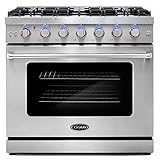
Cooking is, fundamentally, the application of thermal energy to organic matter. It is a transformation of state, texture, and flavor driven by heat. While modern kitchens are filled with induction coils and halogen heaters, the Gas Flame remains the gold standard for many chefs. Why? Because it offers something that electricity struggles to replicate: Analog Feedback and Visual Physics.
A gas range, like the Cosmo COS-EPGR366, is not just a stove; it is a chemical reactor. It facilitates the exothermic oxidation of natural gas (methane) or propane, releasing energy in the form of heat and light. But harnessing this raw energy requires precise engineering. It involves the fluid dynamics of gas flow, the stoichiometry of combustion, and the thermodynamics of heat transfer.
To understand the true capability of a “Pro-Style” range, we must look beyond the stainless steel finish and delve into the physics of the British Thermal Unit (BTU), the aerodynamics of the Venturi Effect, and the material science of Cast Iron. This is an exploration of how we tame fire to feed ourselves.
The Physics of Power: Defining the BTU
In the specification sheet of any gas range, the most prominent number is the BTU rating. The Cosmo boasts two 18,000 BTU burners. But what does this actually mean in terms of physics?
The Energy Unit
A British Thermal Unit (BTU) is defined as the amount of heat energy required to raise the temperature of one pound of water by one degree Fahrenheit.
* 18,000 BTU/hr: This measures the rate of energy delivery. It is equivalent to approximately 5.28 Kilowatts of power.
* Heat Flux: This energy is concentrated into the area of the burner head. High BTU means high Heat Flux (energy per unit area).
Why do we need 18,000 BTUs? It is not just about boiling water faster. It is about Thermal Recovery. When you throw a cold steak into a hot pan, the pan’s temperature drops instantly (Thermal Shock). A high-BTU burner provides the massive energy influx needed to recover that temperature rapidly, ensuring the steak sears (Maillard Reaction at >140°C) rather than steams (at 100°C).
The Stoichiometry of Combustion
Generating 18,000 BTUs requires a precise chemical reaction.
CH_4 + 2O_2 \rightarrow CO_2 + 2H_2O + Heat
For every molecule of Methane (CH_4), you need two molecules of Oxygen (O_2).
If the mix is too lean (too much air), the flame lifts off the burner. If it is too rich (too much gas), the flame turns yellow and produces soot (incomplete combustion).
The engineering challenge is to maintain this stoichiometric ratio automatically, regardless of whether the knob is set to “Low” or “High.”
The Aerodynamics of the Burner: The Venturi Effect
How does the stove get the right amount of air? It uses the Venturi Effect, a principle of fluid dynamics.
Inside the burner assembly, the gas jet shoots gas through a constricted pipe.
1. Velocity Increase: As the gas passes through the constriction, its velocity increases.
2. Pressure Drop: According to Bernoulli’s Principle, as velocity increases, static pressure decreases.
3. Air Entrainment: This low-pressure zone sucks in surrounding air (primary air) through intake ports.
This pre-mixed gas/air blend then travels to the burner ports for ignition. A high-performance burner, like the ones on the Cosmo, must be precision-machined to ensure that the air intake matches the high gas flow rate of 18,000 BTUs. The “Sealed Burner” design prevents spills from clogging these critical air intakes, maintaining the aerodynamics of the system.

The image above shows the Burner Array. Notice the varying sizes. The large burners (front) are designed for high-velocity gas flow and massive air intake. The smaller burners (rear) are tuned for lower flow rates, ensuring stable flames at low settings (simmering) where the Venturi effect is weaker. This “Staged Power” architecture allows the user to select the right tool for the thermodynamic task at hand.
Material Science: The Role of Cast Iron
The grates of the Cosmo range are made of Heavy-Duty Cast Iron. This is not an aesthetic choice; it is a thermal engineering decision.
Thermal Mass and Heat Capacity
Cast iron has a high Volumetric Heat Capacity. It can store a significant amount of thermal energy.
* Buffering: The heavy grates act as a thermal buffer. They absorb fluctuations in the flame intensity, radiating a steady, even heat to the bottom of the pan.
* Emissivity: Cast iron has high thermal emissivity (roughly 0.65 to 0.80). This means it is very good at absorbing and radiating infrared heat. It effectively increases the heat transfer efficiency from the flame to the pot.
Structural Stability
At the temperatures generated by an 18,000 BTU flame (>1000°C at the tip), lesser metals would warp or lose strength. Cast iron maintains its structural integrity through thousands of thermal cycles. It provides a stable, flat platform that will not deform, ensuring that your oil stays in the center of the pan rather than pooling at the edges.
The Control Interface: Analog Precision
In an age of touchscreens, the Cosmo range retains Analog Knobs. From a control theory perspective, this is superior for cooking.
* Infinite Resolution: A digital button gives you discrete steps (1 to 10). A gas valve offers infinite adjustment. You can dial in the flame to the exact millimeter required to maintain a simmer.
* Visual Feedback: The size of the flame gives instant, intuitive feedback on the energy input. You don’t need to read a screen; you can see the physics happening.
The “Knob LEDs” mentioned in the specs are a modern safety addition, indicating which valves are open. But the core mechanism relies on the user’s interaction with the valve flow coefficient (C_v), allowing for the kind of intuitive control that chefs call “cooking by feel.”
Conclusion: The Engine of the Kitchen
The cooktop of the Cosmo COS-EPGR366 is an energy conversion engine. It transforms chemical potential energy (gas) into thermal kinetic energy (heat) with high efficiency and control.
By combining high-BTU output for power with precision valves for control, and supporting it all on thermally stable cast iron, it provides the physical infrastructure for culinary creativity. It respects the laws of thermodynamics, giving the cook the power to manipulate phase changes (boiling), chemical reactions (browning), and emulsions (sauces) at will.


