 smallapps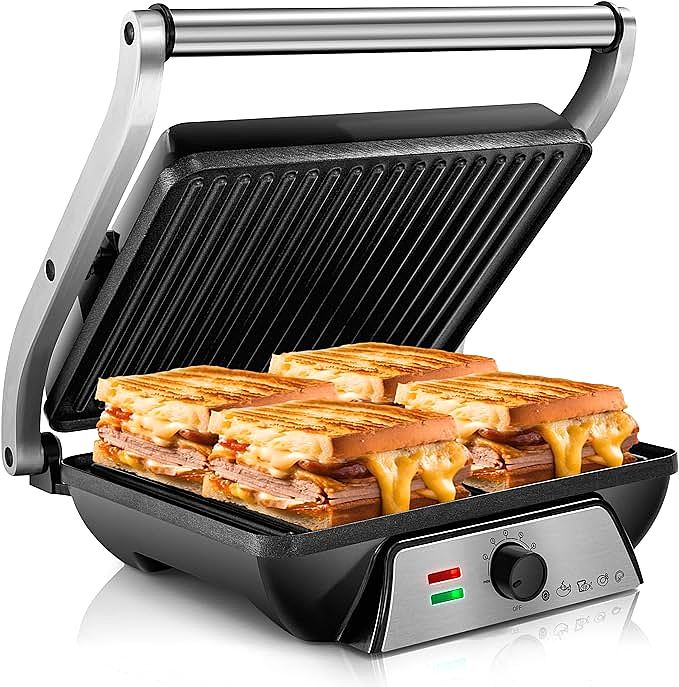

In the culinary world, heat is the transformative agent. Whether it’s the radiant glow of charcoal embers, the convective swirl of an air fryer, or the conductive heat of a cast-iron skillet, the method of delivery defines the outcome. Among these methods, contact grilling stands out as a marvel of efficiency and precision. It is cooking stripped down to its most direct form: the transfer of thermal energy from a heated solid directly to the food.
The SUSTEAS SL-107A 3-in-1 Electric Indoor Grill is a quintessential example of this technology. Often pigeonholed as a mere “sandwich maker,” devices like this are, in reality, sophisticated thermal engines. They leverage the principles of bilateral heat transfer, mechanical pressure, and surface chemistry to achieve results that other methods struggle to replicate. This exploration will peel back the plastic and steel exterior to reveal the science within—exploring why 1500 watts of conductive power creates a unique culinary texture, how a floating hinge solves a complex geometric problem, and why the Maillard reaction thrives under pressure.
The Physics of Heat Transfer: Conduction vs. The World
To understand the unique advantage of an indoor grill, we must first categorize it thermodynamically.
* Outdoor Grills: Primarily rely on Radiation (infrared waves from coals or flames) and Convection (hot air rising). This is excellent for smoky flavor but inefficient in energy transfer. Much of the heat escapes into the atmosphere.
* Ovens: Rely almost exclusively on Convection. Air is a poor conductor of heat, which is why roasting a chicken takes an hour.
* The Contact Grill: Relies on Conduction.
The Efficiency of Direct Contact
Conduction is the transfer of internal energy by microscopic collisions of particles. In the SUSTEAS grill, the aluminum heating plates act as thermal reservoirs. When a steak or a panini is placed on the plate, heat flows directly into the food with zero air gap insulation.
The 1500-watt rating of the SUSTEAS is significant. In a convective system (like a toaster oven), 1500 watts has to heat a volume of air. In a conductive system, that energy is concentrated into the plates. This results in a high Heat Flux Density. The energy has nowhere to go but into the food. This explains the manufacturer’s claim of cooking meals in “10 minutes or less.” It isn’t magic; it’s the physics of direct energy injection.
Bilateral Heating: The End of the Flip
The most defining feature of this appliance is its double-sided heating technology. By applying heat from both the top and bottom simultaneously, the grill effectively halves the cooking time.
But the benefit goes beyond speed. In a frying pan (unilateral heating), the heat must travel from the bottom surface all the way to the top of the food via internal conduction. By the time the center is cooked, the bottom is often overcooked.
With bilateral heating, the thermal distance is cut in half. Heat meets in the middle from both sides. This creates a symmetrical temperature gradient, resulting in more uniform doneness and retaining more moisture within the food matrix because the exposure time to evaporative heat is drastically reduced.

The Maillard Reaction Under Pressure
We cook not just for safety, but for flavor. The gold standard of cooked flavor is the Maillard Reaction—a complex cascade of chemical reactions between amino acids and reducing sugars that gives browned food its distinctive flavor. Think of the crust on a steak, the golden hue of toast, or the sear on a scallop.
The Temperature Threshold
The Maillard reaction accelerates significantly above 285^{\circ}F (140^{\circ}C). However, it competes with another process: evaporation. As long as there is surface moisture turning to steam, the surface temperature of food is capped at 212^{\circ}F (100^{\circ}C). You cannot brown wet food.
The SUSTEAS grill operates in the range of 365°F to 410°F. This is the “Maillard Sweet Spot.” It is hot enough to flash-evaporate surface moisture instantly and trigger browning, but not so hot that it causes instant carbonization (burning).
The Role of Mechanical Pressure
This is where the “Press” in “Panini Press” becomes scientifically interesting. In a skillet, a slightly warped chicken breast or an uneven sandwich only touches the pan at high points. The low points steam instead of sear.
The weight of the top plate on the SUSTEAS grill applies Mechanical Pressure. This forces the food into full contact with the heating surface. It flattens the irregularities. This maximizes the Contact Area, ensuring that the Maillard reaction happens across the entire surface of the food, not just the high spots. This is why a pressed sandwich tastes “nuttier” and more savory than one merely toasted in an oven—the chemical reaction yield is higher due to better physical contact.
Geometry and Mechanics: The Floating Hinge
Applying pressure is good, but applying uneven pressure is disastrous. If you have ever tried to squeeze a thick sandwich in a cheap clam-shell grill, you know the result: the back of the sandwich (near the hinge) gets crushed, while the front remains barely touched. The filling shoots out the front like a projectile.
The Adaptive Z-Axis
The engineering solution utilized by the SUSTEAS SL-107A is the Floating Hinge. Unlike a fixed hinge that rotates around a single axis, a floating hinge allows the top plate to move vertically (along the Z-axis) before it begins to rotate.
This seemingly simple mechanism allows the top plate to remain parallel to the bottom plate, regardless of the food’s thickness. Whether you are grilling a thin slice of bacon or a triple-decker club sandwich, the lid “floats” above it, applying downward pressure evenly.
From a physics perspective, this ensures a uniform Pressure Distribution Field.
1. Uniform Cooking: Heat input is identical across the surface.
2. Structural Integrity: It prevents the mechanical deformation (squishing) of the food at the hinge side.
3. Versatility: It allows the device to act as a grill, a press, or a melting dome (by hovering the plate just above cheese).

Material Science: The Tribology of Non-Stick
The interface between the machine and the meal is the cooking plate. The SUSTEAS utilizes a Non-Stick Coating. In the world of materials science, this involves manipulating Surface Energy.
The Lotus Effect
Food sticks to metal because protein and carbohydrate molecules form chemical bonds with the metal surface as they heat up. Non-stick coatings (often fluoropolymers or ceramics) have extremely low surface energy. They are chemically inert.
This creates a surface where food molecules cannot find a “foothold” to bond. This is crucial for a contact grill for two reasons:
1. Texture Preservation: If food sticks, the delicious crust you just created gets ripped off when you open the lid. Non-stick ensures the crust stays on the food.
2. Oil Reduction: Because the surface is inherently slippery (low coefficient of friction), you do not need to rely on a layer of oil to prevent sticking. This allows for lower-fat cooking without sacrificing the sear.
The specification of being BPA-Free is a critical nod to modern chemical safety. Bisphenol A (BPA) is an industrial chemical used in certain plastics and resins that can exhibit estrogen-mimicking properties. Ensuring the cooking surface—which reaches over 400°F—is free of such compounds is a baseline requirement for health-conscious engineering.
Topological Transformation: The 180-Degree Opening
Most kitchen appliances are static; they have one form. The SUSTEAS grill possesses a degree of topological versatility by opening 180 degrees.
This mechanical transformation changes the device from a Closed System (Contact Grill) to an Open System (Flat-Top Griddle).
* Closed System: High efficiency, double-sided heating, moisture retention. Ideal for steaks, burgers, panini.
* Open System: Doubles the surface area (2 large 11.35 x 9.25 inch plates). Allows for independent manipulation of food on two zones. Ideal for pancakes, eggs, or Korean-style BBQ dining where the cooking is a social, continuous process.
This versatility maximizes the “Utility per Cubic Inch” of the appliance, a critical metric for the modern, space-constrained kitchen.
Conclusion: The Precision of the Press
The SUSTEAS SL-107A is more than a convenience tool; it is a thermal instrument. It solves the fundamental problems of uneven cooking and slow heat transfer through the elegant application of conductive physics and adaptive mechanics.
By understanding the science of the sear, the importance of parallel pressure, and the efficiency of bilateral heating, the home cook can utilize this tool not just to “heat things up,” but to engineer texture and flavor with a level of consistency that a frying pan simply cannot match. It turns the chaotic variables of cooking into a controlled, repeatable scientific experiment—one that happens to taste delicious.


