smallapps
In the daily ritual of coffee preparation, there is a moment of chaos that every home barista dreads. It happens when you pull the grounds bin from the grinder. Instead of a neat pile of fragrant powder, you are greeted by a physics experiment gone wrong. Coffee grounds cling to the walls of the container like iron filings to a magnet. They leap onto the counter, your hands, and your clothes.
This phenomenon is Static Electricity. While often dismissed as a minor annoyance, it is actually a complex manifestation of Triboelectricity and Powder Rheology. For owners of entry-level grinders like the SHARDOR CG835B, managing static is not just about cleanliness; it is about dosing accuracy and extraction consistency.
To master your grinder, you must first understand the invisible forces at play. This article delves into the atomic-level violence of grinding, the insulating properties of coffee beans, and the scientific techniques—like the Ross Droplet Technique (RDT)—that can neutralize the chaos.
The Triboelectric Effect: Violence at the Atomic Level
Grinding coffee is a violent act. Beans are crushed, sheared, and fractured between two metal burrs spinning at high speeds. This mechanical friction generates heat, but it also generates Charge.
Electron Robbery
The mechanism behind this charge is the Triboelectric Effect. When two different materials come into contact and then separate, electrons are often transferred from one to the other.
* The Donors and Acceptors: Coffee beans are organic structures composed of cellulose, oils, and proteins. The grinder burrs are metal. The grounds bin is usually plastic (polycarbonate or ABS).
* The Transfer: As the bean is pulverized against the metal burr, electrons are ripped from their orbits. The coffee particles become positively or negatively charged (depending on the specific triboelectric series of the bean roast).
The Insulator Trap
The problem is compounded by the material properties of coffee. Dry coffee grounds are excellent Electrical Insulators. Unlike a metal wire, they do not allow the charge to flow freely to the ground.
Once a coffee particle acquires a static charge, it holds onto it.
* Coulomb’s Law: Like charges repel; opposite charges attract.
* The Explosion: Because the individual coffee particles all pick up a similar charge, they repel each other violently. This creates the “expanding cloud” effect where grounds fly out of the bin.
* The Adhesion: The plastic bin, being a different material, often develops an opposite charge (or induces a dipole). The charged grounds are attracted to the plastic walls with surprising force, defying gravity.
The Variable of Environment: Humidity and Roast
Static is not a constant; it is a variable dependent on thermodynamics.
1. Ambient Humidity: Water vapor in the air increases the conductivity of the air itself. In humid environments, the static charge on the coffee particles can bleed off into the atmosphere. In dry environments (winter, air-conditioned homes), the air is an insulator, trapping the charge on the grounds.
2. Roast Level: Dark roasts have oils on the surface. Oils can be sticky, but they also change the surface chemistry. Light roasts are denser and drier. Generally, drier beans and drier air create the perfect storm for static.
User “Pat in Cincy” noted, “What i didn’t expect is for the opening… to get clogged. This seems to attract the ground coffee also.” This clogging is a direct result of static adhesion building a bridge of coffee across the chute, eventually blocking it completely.
The Engineering of the Bin: Plastic vs. Metal vs. Glass
The SHARDOR CG835B, like most grinders in its class, uses a Plastic Grounds Bin.
* Cost Efficiency: Plastic is cheap, durable, and lightweight.
* Static Penalty: Plastic is a potent electrical insulator. It sits far apart from organic matter on the triboelectric series, meaning the charge potential difference is high.
High-end commercial grinders often use metal chutes or anti-static flaps (conductive silicone) to provide a path to ground for the electrons. In a plastic-bodied consumer grinder, there is no “Ground Path.” The electrons are trapped in the plastic box with nowhere to go. This is why the “mess” described by users is not a defect of the Shardor specifically, but a fundamental property of plastic-bodied grinders.
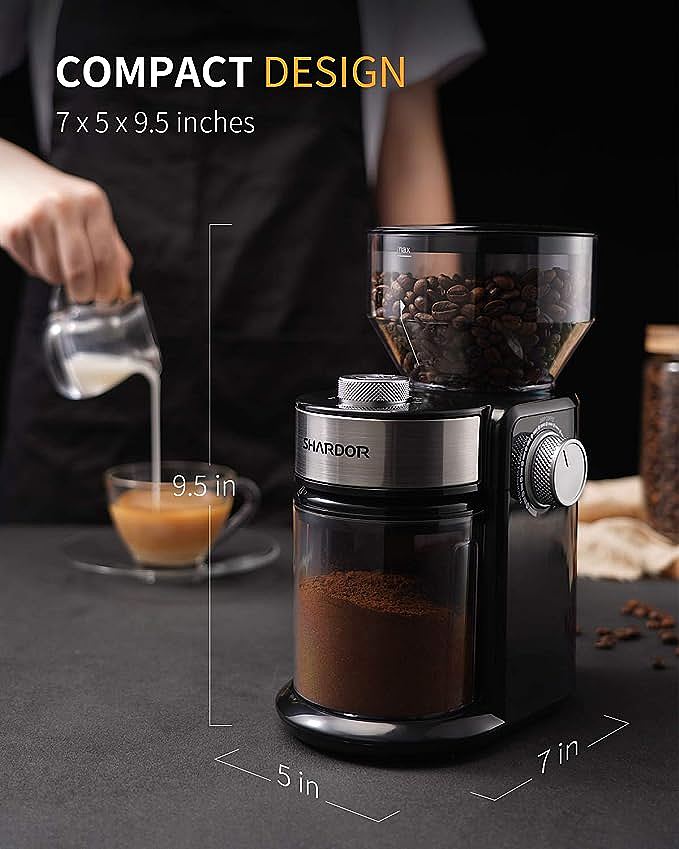
The image above shows the Removable Upper Burr and the cleaning brush. This manual cleaning is the primary defense against static buildup. Over time, coffee oils and fines coat the plastic, creating a sticky layer that exacerbates static adhesion. Regular cleaning resets the surface properties, temporarily reducing the cling.
The Scientific Solution: The Ross Droplet Technique (RDT)
If you cannot change the materials (plastic) or the physics (friction), you must change the Conductivity.
This brings us to the Ross Droplet Technique (RDT), a hack popularized by coffee enthusiasts.
* The Method: Add a tiny drop of water (or a mist spray) to the coffee beans before grinding.
* The Physics: Water is conductive. Even a microscopic layer of moisture on the surface of the beans dramatically increases their electrical conductivity.
* The Result: As the beans are ground, the charge does not build up. It flows through the moisture layer and dissipates into the burrs or the air. The coffee comes out fluffy, static-free, and neat.
For owners of the Shardor, RDT is a game-changer. It transforms a messy $40 grinder into a well-behaved machine. However, caution is needed: adding too much water to a non-commercial grinder can cause rust on the steel burrs or clog the motor. A single drop or a spritz is all the physics requires.
The “Tap and Wait” Protocol
For those hesitant to add water, we can use Time.
Static charge is not permanent. It leaks away over time (unless the air is perfectly dry).
* The Capacitor Effect: The bin full of charged coffee acts like a capacitor.
* Discharge: Waiting 1-2 minutes after grinding allows the charge to dissipate naturally into the air or the countertop.
* Percussive Maintenance: Tapping the side of the bin (“The Tap”) provides kinetic energy to overcome the electrostatic attraction force, dislodging the particles from the walls.
Conclusion: Mastering the Invisible
The static mess associated with grinders like the SHARDOR CG835B is a visible lesson in particle physics. It is a reminder that when we grind coffee, we are interacting with forces at the atomic level.
While manufacturers can mitigate this with anti-static additives in plastics or ionizers (in very expensive models), for the budget-conscious consumer, the solution lies in understanding the science. By manipulating humidity (RDT) or time, we can neutralize the triboelectric effect.
The “mess” is not inevitable; it is a variable waiting to be controlled. Once mastered, the entry-level grinder becomes a precise and clean tool, capable of delivering the grounds for a perfect cup without the countertop cleanup.