 smallapps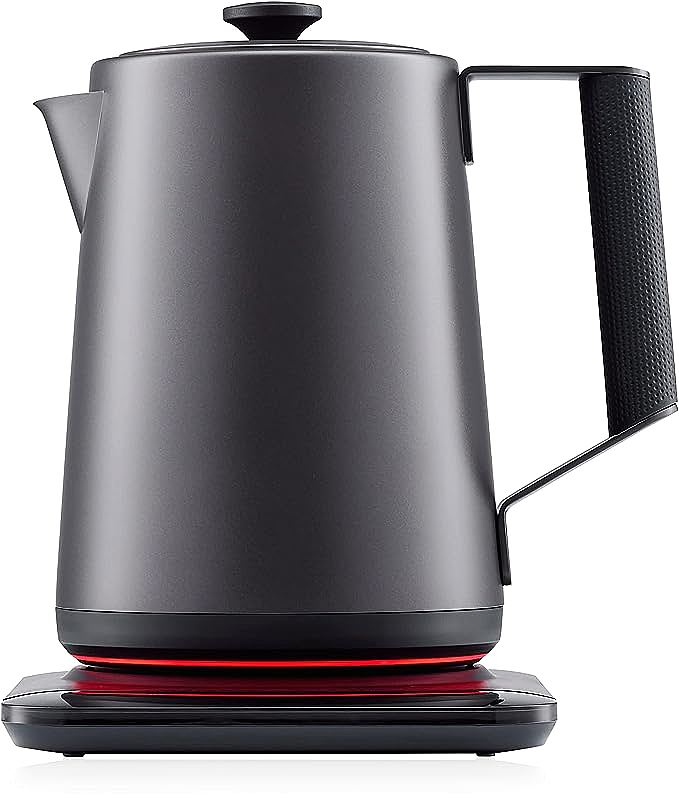

In the culinary sciences, water is often relegated to the status of a mere utility. However, in the context of brewing coffee or tea, water acts as a primary solvent. Its role is to extract soluble compounds from organic matter. The efficiency and selectivity of this extraction are governed by a single, critical variable: Temperature.
The modern electric kettle, such as the SAKI Luna 1.75L, is not simply a device for boiling water. It is a thermal precision instrument designed to manipulate the solvent properties of water. By examining the principles of materials science and thermodynamics, we can understand why specific hardware specifications—like a 1500W heating element and a plastic-free chassis—are essential for optimal organoleptic results.

Material Inertness: The Chemistry of Stainless Steel
The first requirement of any solvent vessel is chemical inertness. As water is heated, its kinetic energy increases, making it a more aggressive solvent. In vessels containing polymers (plastics), high temperatures can facilitate the migration of additives or the breakdown of polymer chains, introducing off-flavors (often described as “plastic taste”) and potentially unwanted compounds into the solution.
The SAKI Luna addresses this via a 100% Plastic-Free Stainless Steel interior. From a materials engineering standpoint, this typically involves Type 304 Stainless Steel.
* The Passivation Layer: Stainless steel contains chromium, which reacts with oxygen to form a microscopic, non-reactive layer of chromium oxide. This “passive film” prevents the underlying iron from interacting with the water.
* Flavor Neutrality: Because this oxide layer is chemically stable at boiling temperatures (212°F/100°C), it ensures that the water remains a neutral medium. It does not contribute metallic ions that could react with the tannins in tea or the acids in coffee, preserving the purity of the brew.

Extraction Kinetics: The Role of Temperature Control
Why does temperature precision matter? Because extraction is selective. Coffee beans and tea leaves contain a complex matrix of compounds, each with a different Solubility Coefficient relative to temperature.
The Polyphenol Balance in Tea
- Amino Acids (Theanine): Responsible for sweetness and umami. These are soluble at lower temperatures (around 160°F-175°F).
- Catechins and Tannins: Responsible for bitterness and astringency. These require higher energy states to dissolve efficiently.
If you brew delicate Green Tea with boiling water (212°F), you rapidly extract the bitter tannins, overwhelming the delicate amino acids. The result is an astringent, unbalanced cup.
The SAKI Luna’s 7 Temperature Presets are effectively pre-programmed extraction algorithms.
* 175°F (Green Tea): Optimizes for amino acid retention while limiting tannin release.
* 200°F (Coffee/Oolong): Provides sufficient energy to extract lipids and heavier oils without burning the grounds.
* 212°F (Black Tea/Herbal): Maximum energy for breaking down fibrous cellular structures to release full-bodied flavor profiles.
By allowing manual control alongside presets, the device transforms from a simple heater into a variable-variable extraction tool.

Thermal Engineering: Power and Mass
The specification of 1500 Watts is a measure of energy transfer rate (Power = Energy / Time).
Heating 1.75 Liters of water (a mass of approximately 1.75 kg) requires a significant input of energy to overcome the specific heat capacity of water (4.186 Joules/gram \cdot °C).
- Joule Heating Efficiency: A 1500W element converts electrical energy into thermal energy at near 100% efficiency within the element itself. Submerged heating (or direct base heating) minimizes heat loss to the environment compared to stovetop methods.
- Ramp-Up Rate: High wattage ensures a rapid temperature ramp-up. This is not just about convenience; it reduces the time the water sits in the “danger zone” of tepid temperatures and ensures that when the target is reached, the thermal momentum is sufficient to maintain stability.
- Thermal Mass Management: With a large capacity (1.75L), the water acts as its own thermal battery. Once heated, the 60-Minute Keep Warm function requires minimal energy pulses to maintain the set point, as the large volume of water retains heat effectively due to its high heat capacity.
Safety Systems: The Physics of Shut-Off
Reliability in thermal appliances relies on robust feedback loops.
* Boil-Dry Protection: This typically utilizes a bimetallic strip—a mechanical sensor made of two metals with different thermal expansion coefficients. If the temperature exceeds a safety threshold (indicating no water is present to absorb the heat), the strip physically deforms, breaking the circuit. This is a fail-safe mechanism rooted in the physical properties of metals, ensuring the 1500W element does not melt or cause a fire hazard.
Conclusion: The Instrument of the Brewer
The electric kettle has evolved. It is no longer just about making water hot; it is about preparing a solvent to exact specifications. The SAKI Luna illustrates how material science (stainless steel inertness) and thermal engineering (high-wattage precision) converge.
For the enthusiast, investing in such a device is an acknowledgment that the quality of the output (the tea or coffee) is inextricably linked to the quality of the input conditions. Precision heating is the first step in the chemistry of a perfect cup.


