 smallapps
The evolution of the modern kitchen is a narrative of miniaturization and acceleration. In our relentless pursuit of speed, fueled by the advent of microwave technology in the 1970s and the recent ubiquity of high-velocity convection (air frying), we have arguably drifted from the fundamental principles that govern the art of transmutation through heat. We have prioritized the rate of energy transfer over the quality of energy distribution. However, a quiet renaissance is underway. Serious home cooks and culinary enthusiasts are increasingly looking back to the foundational physics of baking and roasting—principles that rely not on turbulent air, but on the steady, penetrating power of radiant heat and the thermal stability of significant volume.
This shift represents a return to “slow physics,” where the objective is not merely to heat food rapidly, but to orchestrate chemical reactions—protein denaturation, starch gelatinization, and the Maillard reaction—with precision. In this context, the appliance on the counter is no longer just a reheating station; it is a thermal reactor. Understanding the interplay between cavity volume, heating element configuration, and control interfaces is essential for anyone seeking to replicate the results of a traditional brick oven or a professional deck oven within the constraints of a residential kitchen. This exploration delves into the science of these thermal dynamics, examining why specific configurations, such as large-capacity static ovens with independent zone controls, remain the gold standard for a wide spectrum of culinary tasks.
The Physics of the Cavity: Thermal Mass and Volumetric Stability
To understand why “size matters” in an oven, one must first grasp the concept of thermal mass and temperature stability. In the realm of thermodynamics, a small enclosed space heats up quickly but is also highly susceptible to rapid temperature fluctuations. Every time the door of a standard, compact toaster oven is opened to baste a roast or check a cake, a significant percentage of the heated air escapes, causing the internal temperature to plummet. This thermal shock can be catastrophic for delicate structures like soufflés or yeast breads, which rely on consistent heat for proper expansion (oven spring).
The Buffer Effect of Volume
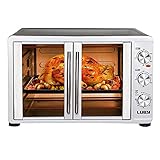
A large-capacity oven—defined here as exceeding the standard 20-30 liter range and approaching the 50-60 liter territory—operates on a different physical premise. Consider the LUBY GH55-H, which boasts a substantial 55-liter interior. While this product serves as a tangible example of this category, the principle applies universally: a larger volume of air and the accompanying increased surface area of the metal chassis create a more robust thermal buffer.
When a 55-liter cavity is heated to 400°F, it contains a greater total amount of thermal energy compared to a 20-liter cavity at the same temperature. When the door is opened, the percentage of heat loss relative to the total stored energy is often lower, and the recovery time—the time it takes to return to the set temperature—can be managed more effectively by the heating elements. This stability is crucial for “long-format” cooking, such as roasting a 20-pound turkey or slow-baking a dense fruit cake. The oven acts less like a flashlight flickering on and off, and more like a reservoir of heat, smoothing out the peaks and valleys of the cooking cycle.

Spatial Airflow and Natural Convection
Even in an oven without a forced-air fan (a “static” oven), air is never truly still. Natural convection occurs as air heated by the bottom elements rises, cools slightly upon contact with the food or the oven ceiling, and then descends. In a cramped, small-volume oven, these natural convection currents are stifled. Food placed too close to the heating elements blocks the airflow, leading to scorching on one side and undercooking on the other.
In a large-format countertop architecture, specifically one deep enough to accommodate a 14-inch pizza or wide enough for two standard baking sheets, these natural currents have the “breathing room” to circulate efficiently. This gentle, buoyancy-driven air movement ensures a more uniform heat distribution without the drying effect often associated with high-speed fans. This is the secret to why a large countertop oven can often bake a batch of muffins more evenly than its smaller, more crowded counterparts. The “dead zones” (cold spots) are minimized because the thermal fluid (air) is allowed to move according to the laws of physics, unencumbered by spatial restrictions.
Radiant Heat vs. Forced Convection: The Case for “Stillness”
The current market is saturated with “Air Fryer” hybrids, leading to a misconception that forced convection is superior for all applications. While fans are excellent for dehydration and rapid crisping, they are aggressive. They strip moisture from the surface of food rapidly. For a french fry, this is desirable. For a cheesecake, a custard, or a delicate sponge cake, it is detrimental.
The Mechanism of Infrared Radiation
Ovens like the LUBY GH55-H utilize metal heating tubes to generate radiant heat. This form of heat transfer involves the emission of electromagnetic waves (infrared radiation) that travel through space and are absorbed by the food. Unlike convection, which relies on air to carry heat, radiant heat is direct. It mimics the heating action of the sun or the glowing embers of a wood fire.
This direct energy transfer is particularly effective for:
1. Broiling and Browning: Intense infrared radiation from the top elements can caramelize sugars and brown proteins (Maillard reaction) efficiently without overcooking the center of the food.
2. Deep Penetration: Radiant heat can penetrate the surface of food to a certain depth, helping to cook the interior of dense meats like a tenderloin or a turkey roast, while convection primarily acts on the very exterior.
The Preservation of Moisture
The absence of a high-velocity fan in a traditional large-capacity oven is a feature, not a deficit, for specific culinary arts. By maintaining a “still” environment, the oven allows a micro-climate of humidity to develop around the food. As a roast chicken releases moisture, that vapor hangs in the immediate vicinity, effectively self-basting the bird and keeping the meat succulent. A convection fan would blow this protective boundary layer away instantly.
This principle is why professional bread bakers often turn off their convection fans during the initial stage of baking. They need the dough to remain moist and flexible to expand fully before the crust sets. A static, radiant-heat oven inherently supports this process, making it a superior choice for artisan breads, braises, and delicate pastries where moisture retention is paramount.
The Chemistry of Control: Independent Zone Management
The transformation of raw ingredients into a cooked dish is fundamentally a chemical process driven by heat. However, not all chemical reactions require the same energy input. The Maillard reaction (browning) occurs rapidly above 300°F (150°C), while the gelatinization of starches and the denaturation of proteins happen at lower, more sustained temperatures.
The Necessity of Differential Heating
Sophisticated cooking often requires different heat intensities from different directions. A pizza, for instance, requires intense heat from below to crisp the crust (conductive and radiant heat) and moderate to high heat from above to melt the cheese without burning the toppings. Conversely, a lasagna might need a gentle simmer from the bottom to cook the pasta through, followed by a blast from the top to brown the bechamel.
Standard toaster ovens often link the top and bottom elements to a single thermostat—you get the same temperature everywhere. The LUBY GH55-H exemplifies a more professional approach with its separate temperature selectors for the upper and lower heating tubes. This allows the cook to set, for example, the bottom elements to 400°F and the top elements to 300°F.

Sculpting with Heat
This independent control capability turns the oven into a precision instrument.
* For Baking: If a cake is rising well but the top is browning too fast, the cook can lower the top element temperature while maintaining the bottom heat to ensure the structure sets.
* For Roasting: One can start with high heat from both zones to sear a roast, then turn off the top element and lower the bottom element to finish cooking gently, preventing the top from charring during a long cook time.
This level of granularity empowers the cook to “sculpt” the thermal profile of the oven chamber, adapting it to the specific needs of the ingredients rather than forcing the ingredients to submit to a generic heat setting. It requires a deeper engagement with the cooking process—a move away from “set it and forget it” towards active culinary management.
The Analog Interface: Reliability in an Age of Obsolescence
In an era dominated by touchscreens and Wi-Fi connectivity, the persistence of mechanical control knobs—simple, rotating dials—might seem anachronistic. However, from an engineering and usability standpoint, the analog interface holds significant advantages that contribute to the “evergreen” nature of an appliance.
Hick’s Law and Cognitive Load
Hick’s Law states that the time it takes to make a decision increases with the number and complexity of choices. Modern digital appliances often bury basic functions under layers of menus, presets, and sub-screens. To simply turn on an oven to 350°F might require three or four taps and a scroll.
Mechanical knobs, like those found on the LUBY model (Temperature, Time, Function), offer immediate, 1:1 tactile mapping. You want 350°F? You turn the dial to 350. You want 40 minutes? You turn the timer. The cognitive load is near zero. This immediacy creates a seamless workflow in a busy kitchen where the cook’s hands may be covered in flour or oil, conditions that often confuse capacitive touchscreens.
The Durability of Simplicity
Electronic control boards are sensitive. They are vulnerable to heat, moisture, and power surges—all common in a kitchen environment. A capacitor failure on a digital motherboard can render a perfectly good oven useless, often costing more to repair than to replace.
Mechanical thermostats and timers are robust physical switches. They can withstand higher operating temperatures and are generally impervious to steam and grease. If a mechanical timer fails, it is often a simple, modular component that can be replaced or bypassed. This structural simplicity aligns with the philosophy of long-term ownership and repairability, contrasting sharply with the “disposable” nature of high-tech gadgets that become obsolete as soon as their software is no longer supported.
Architectural Integration: The “French Door” Solution
While we have focused heavily on the internal physics, the external architecture of a large countertop oven dictates its integration into the kitchen ecosystem. The transition from a pull-down door to a French door design is not merely aesthetic; it is a solution to a geometric problem.
The Lever Arm Problem
A standard pull-down door, when fully open, extends significantly into the workspace. On a narrow countertop, this can block the user’s body, forcing them to stand awkwardly to the side when inserting or removing heavy pans. For a 55-liter oven, a single pull-down door would be massive and heavy.
The French door design splits this swing radius in half. Opening the doors requires less clearance in front of the unit (the sagittal plane). This allows the user to get closer to the oven cavity, improving leverage when handling heavy items like a 20lb turkey or a large cast-iron dutch oven. It reduces the strain on the user’s lower back and minimizes the risk of burns from reaching over a hot oven door.

Thermal Retention During Access
Furthermore, the split-door design offers a subtle thermal advantage. If a cook needs to quickly check the internal temperature of a roast or baste it, they can potentially open just one side (if the design permits or if the access angle allows), or opening both doors creates a different airflow pattern than the “scoop” effect of a pull-down door which can drag a large volume of hot air out as it opens. While the LUBY’s doors are linked to open together for convenience, the reduced movement of air mass compared to a large single slab door helps in maintaining that critical thermal buffer we discussed earlier.
Conclusion: The Timeless Utility of the Thermal Chamber
The resurgence of interest in large-capacity, radiant-heat countertop ovens suggests a maturing of the market. Consumers are looking past the hype of “smart” features and returning to the fundamentals of cooking: capacity, control, and reliability.
The LUBY GH55-H serves as a prime case study in this philosophy. By prioritizing a massive 55-liter volume, it secures the thermal stability necessary for serious baking. By employing independent heating zones, it offers the chemical control required for complex roasting. By utilizing simple mechanical interfaces, it ensures longevity and ease of use. And by adopting the French door architecture, it solves the ergonomic challenges inherent in bringing such capacity to a countertop.
This is not a rejection of technology, but a refinement of it. It is the recognition that in the physics of cooking, some laws are immutable. Heat requires mass to be stable. Browning requires direct radiation. And the cook requires a tool that is predictable, robust, and generous in its capacity to nourish. As we look to the future of kitchen appliances, the most enduring designs will likely be those that, like these large radiant ovens, respect the timeless science of heat over the fleeting trends of software.


