smallapps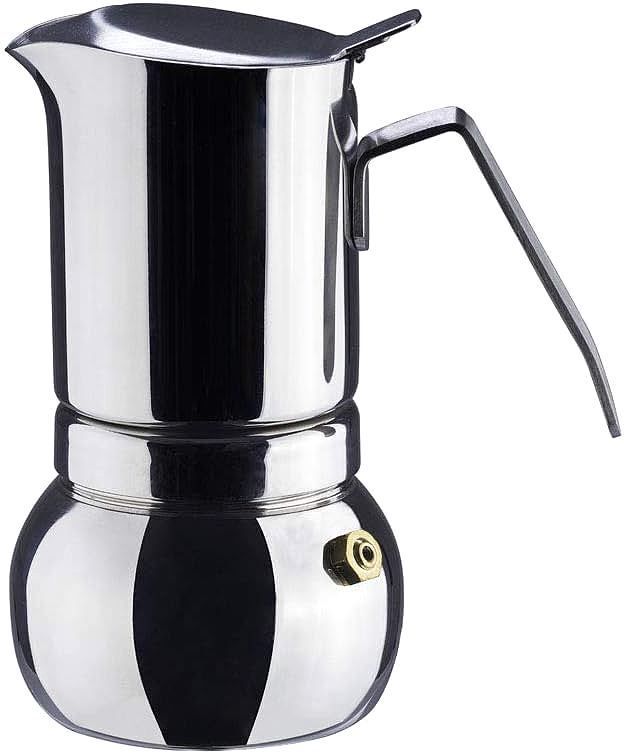
In the pantheon of coffee brewing methods, the Moka Pot stands apart. It is not gravity-fed like a drip brewer, nor is it pump-driven like a modern espresso machine. It is a thermodynamic engine—a device that harnesses the expansive power of phase-changing water to defy gravity.
Invented in 1933 by Alfonso Bialetti, the Moka Pot brought the intensity of espresso into the home kitchen using nothing but basic physics. However, the modern iteration, exemplified by the Début MK-STELLA-494, elevates this crude engine into a precision instrument. By utilizing high-grade stainless steel and precision machining, it refines the variables of heat and pressure.
To truly master the Moka Pot, one must understand it not just as a coffee maker, but as a Pressure Vessel. We must delve into the Ideal Gas Law, the dynamics of Steam Pressure, and the delicate balance of Hydraulic Resistance. This is the physics of the stovetop geyser.
The Thermodynamic Cycle: Anatomy of a Geyser
The operation of a Moka Pot is a three-act play of thermodynamics. It relies on the relationship between Temperature, Volume, and Pressure (PV=nRT).
Act 1: The Isochoric Heating
The bottom chamber (boiler) is filled with water and sealed. As heat is applied, the water temperature rises.
* Vapor Pressure: Water molecules escape the liquid phase and become gas (steam). In a sealed container, this gas builds pressure.
* Expansion: The air trapped above the water line also expands as it heats up.
Together, the steam and expanding air create a downward force on the surface of the water.
Act 2: The Hydraulic Lift
The only escape route for the water is the funnel—a tube that dives deep into the liquid. As the pressure in the headspace exceeds atmospheric pressure, it pushes the water down.
Since liquids are incompressible, this force drives the water up the funnel tube. This is a hydraulic displacement. The water is forced upwards, through the bed of coffee grounds.
Act 3: The Extraction Phase
This is where the Moka Pot differs from true espresso.
* Espresso Machine: Uses a pump to force water at 9 Bars (approx. 135 PSI).
* Moka Pot: Uses steam pressure to force water at roughly 1-2 Bars (approx. 15-30 PSI).
This lower pressure means the water temperature is higher (often >100°C) when it hits the coffee. The result is a unique extraction profile—richer in heavy oils than drip coffee, but lacking the emulsified crema of 9-bar espresso. The Début pot, with its heavy stainless steel construction, allows for a more controlled heat retention, stabilizing this volatile process.
The Engineering of Resistance: The Coffee Puck
The coffee grounds in the funnel act as a Resistor in this hydraulic circuit.
* Darcy’s Law: The flow rate of fluid through a porous medium is determined by the pressure difference and the permeability of the medium.
If the grind is too coarse, permeability is high. The water shoots through too fast (Channeling), resulting in sour, under-extracted coffee.
If the grind is too fine, permeability is low. The pressure required to push water through exceeds the safety limit of the pot. The safety valve triggers, venting steam, and the coffee burns in the basket.
The “Goldilocks Grind” for a Moka Pot is strictly defined by physics: finer than drip, coarser than espresso. It must provide enough resistance to build 1-2 bars of pressure, but not so much that it chokes the flow. The Début MK-STELLA-494’s precision filter screen is engineered to support this specific particle size range without clogging.
The Safety Valve: A Critical Thermodynamic Fail-Safe
Every Moka Pot features a small brass nipple on the side of the boiler: the Safety Valve.
In engineering terms, this is a Pressure Relief Valve (PRV).
It consists of a spring-loaded piston. The spring is calibrated to compress at a specific pressure (usually around 3-4 Bars).
Why is it needed?
If the user grinds the coffee too fine (creating a blockage) or leaves the pot on high heat for too long, the pressure inside the boiler could theoretically continue to rise until the metal vessel ruptures (explodes).
The safety valve provides a path of least resistance. Before the pressure reaches the bursting point of the steel, the spring compresses, and the steam vents harmlessly out the side.
The Début pot emphasizes a “high quality made in Italy” valve. This is not trivial. A cheap valve might stick (fail to open) or open too early (ruining the brew). The reliability of this simple mechanical component is the only thing standing between the user and a shrapnel grenade in the kitchen.
The Reducer: Controlling the Variable of Mass
A unique feature of the Début MK-STELLA-494 is the Reducer.
In coffee brewing, the Brew Ratio (ratio of coffee mass to water mass) is critical for flavor balance.
A Moka Pot is designed to work at full capacity. The basket must be full to create the correct hydraulic resistance. If you only half-fill the basket with coffee, the water channels through the loose grounds, creating weak, muddy coffee.
The Reducer is a physical spacer plate. It essentially raises the floor of the basket.
* Volume Reduction: It cuts the volume of the basket in half.
* Resistance Maintenance: By reducing the volume but keeping the puck geometry (depth) correct for a smaller dose, it allows the user to brew a “half pot” without sacrificing the hydraulic resistance needed for proper extraction.
This transforms the Moka Pot from a fixed-capacity device into a variable-capacity tool, a significant engineering upgrade over the classic design.

The image above displays the exploded view. You can clearly see the Funnel (the central tube) and the Reducer (the small disc). This modularity is key to the device’s versatility and ease of maintenance. Every part that touches coffee or water is accessible, ensuring that the physics of the flow path remain unobstructed by scale or oil buildup.
The Variable of Heat: Thermal Inertia
The heat source drives the entire process.
* Gas Flame: Provides intense, focused heat.
* Induction: Provides efficient, magnetic heating.
The Début pot is made of Stainless Steel. Compared to aluminum (the traditional material), stainless steel has lower thermal conductivity.
* Aluminum: Heats up fast, cools down fast.
* Stainless Steel: Heats up slower, holds heat longer.
This Thermal Inertia changes the brewing curve. A stainless steel pot requires a slightly longer pre-heat phase, but once it reaches temperature, it maintains a steady vapor pressure. This stability prevents the “surging” (sputtering) often seen in aluminum pots, leading to a smoother, more continuous flow of coffee into the upper chamber. It also means the pot stays hot longer after brewing, which can cook the coffee if not poured immediately—hence the pro tip to run the base under cold water to stop the reaction.
Conclusion: The Desktop Steam Engine
The Début MK-STELLA-494 is a triumph of industrial design applied to classical physics. It takes the fundamental principles of the steam engine—pressure, heat, and displacement—and miniaturizes them for the purpose of pleasure.
By refining the materials (stainless steel) and adding control mechanisms (reducer), it modernizes the Moka Pot without losing its soul. It reminds us that brewing coffee is not just a chemical extraction; it is a physical event. It is the harnessing of energy to force water through stone-hard beans, extracting the essence of the fruit. Understanding the physics of this process turns the daily routine into a daily experiment in thermodynamics.