smallapps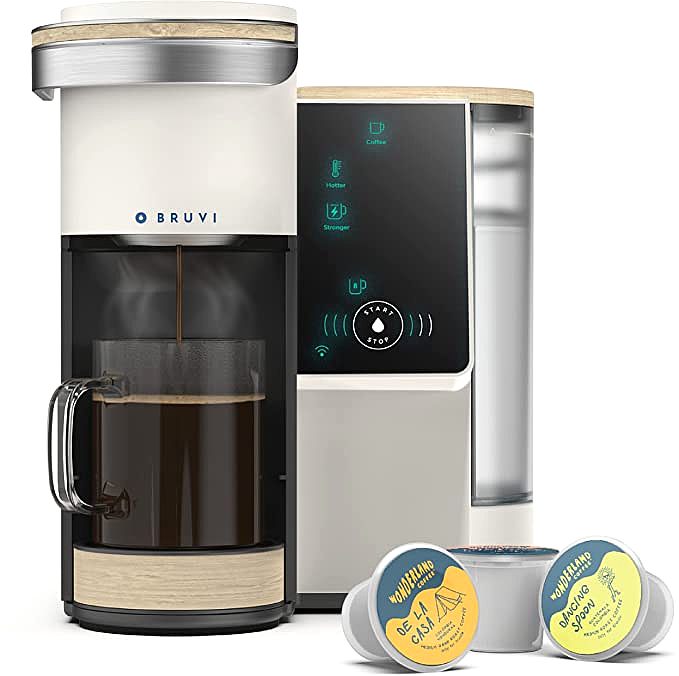

For decades, the single-serve coffee segment has been defined by a stark compromise: the trade-off between velocity and viscosity. The convenience of a push-button brew often came at the cost of extraction quality, resulting in beverages that lacked the complexity of a manual pour-over. Furthermore, the environmental toll of billions of spent plastic casings has cast a long shadow over the industry.
However, a new wave of engineering is attempting to rewrite this narrative. By integrating precision fluid dynamics and advanced polymer science, modern systems are moving beyond mere convenience devices to become sophisticated extraction instruments. The Bruvi BV-01 Single-Serve Coffee System serves as a prime example of this technological evolution, prioritizing the Golden Cup Standard and rethinking waste management through a biochemical lens.

The Extraction Equation: Breaking the “Weak Coffee” Barrier
To understand why traditional pods often taste watery, we must look at the Brew Ratio—the mass of ground coffee relative to the mass of water. A standard pod typically contains 9-11 grams of coffee. When subjected to a 10-ounce brew cycle, the ratio becomes too dilute to achieve optimal Total Dissolved Solids (TDS), the metric that defines the “strength” and “body” of the cup.
The 15-Gram Threshold
The Bruvi system addresses this physics problem with brute force: mass. By engineering pods (B-Pods) that hold up to 15 grams of coffee, the system fundamentally alters the extraction potential.
* Saturation: More grounds allow for a more substantial coffee bed, ensuring that water channels evenly rather than sprinting through, a phenomenon known as channeling.
* Solubility: With a higher dose, the system can extract the desirable 18-22% of soluble compounds (the Specialty Coffee Association’s target) without over-extracting bitter tannins to compensate for a lack of material.
Algorithmic Extraction: “Auto Optimized Brewing”
True extraction control involves more than just hot water. It requires the modulation of variables. The Bruvi uses a camera-based scanning system to read the pod’s lid. This is not merely for flavor identification; it is a trigger for Variable Parameter Modulation.
Unlike mechanical brewers that simply pump water, this system adjusts up to seven parameters, likely including:
1. Temperature Profiling: Adjusting heat (195°F for coffee vs. 200°F+ for light roasts) to maximize solubility without scalding.
2. Pressure Profiling: Differentiating between the low-pressure soak needed for drip coffee and the 20-bar spike required to emulsify oils for espresso crema.
3. Pre-Infusion: A pause in the water flow to allow the coffee bed to bloom (degas CO2), preventing carbonic acid from souring the brew.

Material Science: The Anaerobic Degradation Paradigm
Perhaps the most significant innovation lies not in the machine, but in the polymer chemistry of the consumable. The industry standard “recyclable” pod is often a fallacy in practice—it requires consumer separation of foil, grounds, and plastic, a friction point that leads most pods to the trash.
Bio-Enzyme Infused Polymers
Bruvi tackles this reality with Guilt Free Toss® technology. Instead of relying on municipal recycling infrastructure (which often rejects small plastics), these pods are engineered for the landfill environment.
* The Mechanism: The plastic is infused with a proprietary bio-enzyme. In an aerobic environment (your kitchen shelf), the plastic remains stable. However, in the anaerobic (oxygen-free), biologically active environment of a landfill, these enzymes act as a catalyst.
* The Breakdown: The enzymes attract naturally occurring microbes to digest the polymer structure, converting it into organic biomass and biogas (which many modern landfills capture for energy).
* The Result: This process aims to eliminate the generation of permanent microplastics, offering a pragmatic solution that aligns with actual consumer behavior rather than aspirational recycling habits.
Fluid Dynamics: The Hygienic Loop
Flavor cross-contamination is the nemesis of single-serve machines. The residue of a bold dark roast can easily ruin a delicate tea brewed immediately after. Traditional machines force coffee through a fixed internal needle and spout, creating a buildup of coffee oils (which turn rancid) and bacterial matrices.
The Bruvi employs a Direct-to-Cup architecture. The brewing occurs entirely within the B-Pod. The exit needle is part of the pod itself, not the machine.
* Isolation: The coffee never touches the brewer’s internal components.
* Thermal Inertia: This design also minimizes heat loss, as the liquid doesn’t travel through extensive unheated plastic piping before hitting the cup.

Thermodynamics of the “Cold Brew”
Creating cold brew coffee traditionally requires time (12-24 hours) for diffusion to occur at low temperatures. How does a machine do it in minutes?
The Bruvi utilizes Interval Brewing. Instead of a continuous stream of hot water, the system likely pulses lower-temperature water (or creates short, high-concentration hot blooms followed by cool water) to extract flavor compounds without releasing the heavy, acidic oils that are soluble only at high heat. While distinct from immersion cold brew, this thermodynamic trick mimics the low-acid profile consumers desire, delivering a chemically distinct beverage from simply “iced coffee.”

Conclusion: Engineering a Sustainable Future
The Bruvi BV-01 represents a maturity in the single-serve appliance market. It acknowledges that convenience should not require a sacrifice in physics (extraction quality) or environmental ethics. By leveraging 15-gram doses for proper TDS and bio-active polymers for realistic waste management, it bridges the gap between the craft coffee movement and the modern need for speed.
For the consumer, this is not just a coffee maker; it is a validation that technology, when applied to the entire lifecycle of a product, can solve the very problems it created.