 smallapps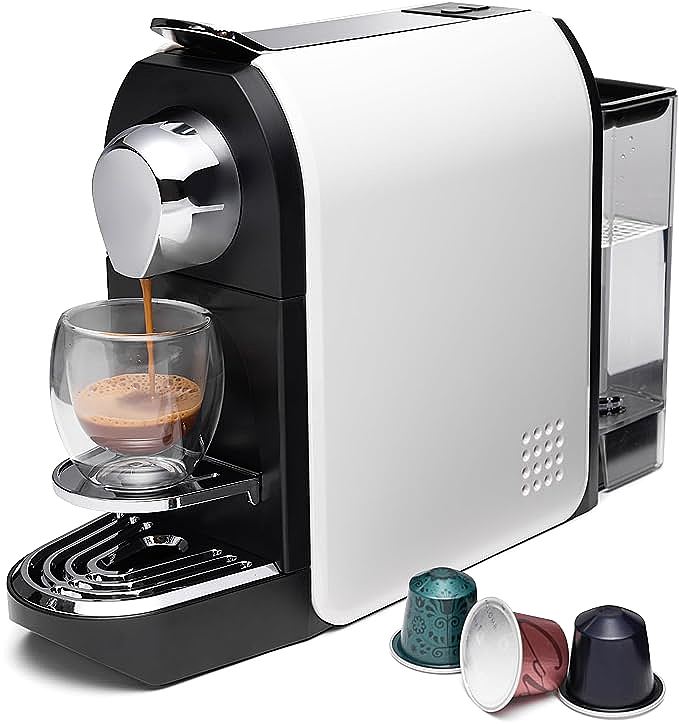

In the engineering of domestic appliances, miniaturization is a game of trade-offs. Shrinking a coffee machine is not merely about making components smaller; it requires a fundamental rethinking of thermal management, fluid dynamics, and structural acoustics.
The beanglass BGS-C03 Mini Espresso Machine represents a specific archetype in this field: the high-pressure, low-mass extraction unit. By analyzing its 19-bar pump and 1400-watt heating system, we can understand the physics that allow such a compact device to emulate the output of commercial machinery, and the inevitable physical byproducts—such as noise—that accompany this feat.

The Pressure Paradox: 19 Bars in a Micro-Chassis
A common question in espresso mechanics is: “Why does a 100 home machine boast 19 bars of pressure when a 20,000 La Marzocco operates at 9 bars?” The answer lies in the type of pump employed.
The Dynamics of the Vibration Pump
Commercial machines use Rotary Pumps, which deliver consistent pressure instantly. Compact units like the BGS-C03 utilize Vibration Pumps (solenoid pumps).
* Mechanism: An electromagnetic piston oscillates back and forth at 60Hz (line frequency), pushing water in pulses.
* Pressure Curve: The rating of “19 Bars” refers to the pump’s maximum pressure at zero flow. However, vibration pumps have a steep pressure drop curve. By the time the water overcomes the resistance of the internal piping, the thermoblock, and the dense coffee puck inside the capsule, the effective pressure at the extraction point settles closer to the desired 9-12 bar range.
* Engineering Intent: The 19-bar rating provides the necessary hydraulic overhead to ensure that even with a tightly packed or slightly clogged capsule, the machine can still force water through to complete the extraction.

Acoustics and Structural Mass: Why It’s “Loud”
User feedback frequently cites noise (“sounds like it’s breaking apart”) as a characteristic of this machine. From a physics perspective, this is an expected outcome of High Power Density combined with Low Structural Mass.
- The Source: The vibration pump creates significant kinetic energy. In a heavy commercial machine, the metal chassis dampens this energy.
- The Resonator: The BGS-C03 weighs only 5.5 lbs (2.5 kg) and features a plastic housing. Instead of absorbing the 60Hz vibration, the lightweight casing can vibrate sympathetically, acting as a resonator board that amplifies the sound.
- The Conclusion: The noise is not a defect; it is the physical signature of a powerful motor operating without the “dead weight” of sound-dampening materials. It is the compromise made for portability and compactness.
Thermal Velocity: 1400 Watts of Flash Heat
The machine’s ability to pre-heat in 25 seconds is achieved through Thermoblock Technology. Unlike a boiler that heats a reservoir of water, a thermoblock is a metal labyrinth heated by high-wattage elements.
* Heat Transfer: Water passes through the superheated maze and reaches brewing temperature instantly.
* Energy Efficiency: The 1400-watt input is directed entirely at the water stream in motion. This minimizes energy waste (heating water you don’t use) and allows for the Auto Shut-Off feature to be aggressive (turning off after 9 minutes) without inconveniencing the user, as recovery time is negligible.

Fluid Dynamics of the Capsule: The Flow Restrictor
The compatibility with Nespresso Original Pods means the machine relies on the capsule itself as the brew chamber.
* Aeration: The high-pressure water jet creates turbulence within the capsule. This turbulence emulsifies the coffee oils with carbon dioxide, generating the Crema.
* Flow Control: The foil lid of the capsule ruptures against the machine’s pyamid plate only when internal pressure reaches a critical threshold. This ensures that extraction occurs under pressure, which is essential for emulsifying the insoluble oils that give espresso its body.
Conclusion: The Engineering of Efficiency
The beanglass BGS-C03 is a study in functional density. It packs the essential hydraulic components of espresso preparation—high pressure and rapid heat—into a footprint scarcely larger than a toaster.
While it lacks the acoustic refinement and thermal stability of larger machines, it succeeds as a purpose-built hydraulic tool. For the user, understanding that the noise is a byproduct of power, and the pressure rating is a necessity of the pump type, transforms the usage experience from one of confusion to one of technical appreciation.


