 smallapps
The craving for “crispy” is evolutionary. It signals high energy density (fat) and the safety of cooked food (sterilization). For centuries, the only way to achieve this texture was Deep Frying—submerging food in hot oil. Oil is a magnificent heat transfer medium. It envelops the food perfectly, delivering heat 50 times faster than air.
However, oil comes with caloric and health costs. The modern kitchen seeks a paradox: deep-fried texture without the deep fryer. Enter the Air Fryer Oven, a device that attempts to mimic the physics of oil using the physics of air.
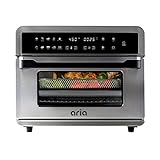
The Aria ATO-898 30 Qt. Air Fryer Oven claims to reduce fat by up to 90% while cooking 30% faster. This is not just marketing; it is a claim rooted in Fluid Dynamics and Convective Heat Transfer. To understand how a box of hot air can replicate a vat of hot oil, we must delve into the science of the Boundary Layer, the Reynolds Number, and the Maillard Reaction.
The Medium of Heat: Air vs. Oil
Heat transfer is governed by the equation:
Q = hA(T_{medium} – T_{surface})
Where:
* Q is the heat transfer rate.
* A is the surface area.
* T is the temperature difference.
* h is the Heat Transfer Coefficient.
In a standard oven (natural convection), h is very low (approx. 5-25 W/m^2K).
In a deep fryer (oil), h is extremely high (approx. 50-1000 W/m^2K).
This massive gap explains why an oven bakes while a fryer fries. The rate of energy delivery in oil creates immediate surface dehydration (crisping) before the interior dries out.
The Engineering of AriaFlow™: Boosting the Coefficient
To make air act like oil, we must artificially boost the heat transfer coefficient (h).
This is achieved through Forced Convection. The Aria ATO-898 utilizes a high-velocity fan to circulate air.
* Velocity: Increasing air velocity disrupts the stagnant layer of insulating air that naturally surrounds the food (the Thermal Boundary Layer).
* Turbulence: The “AriaFlow™” technology likely involves baffle designs or fan placement that creates turbulent flow. In fluid dynamics, turbulence increases the mixing of hot air molecules with the food surface, significantly increasing heat transfer.
By pushing air at high speeds, an air fryer can raise the effective h to 50-100 W/m^2K. While still lower than oil, it is high enough to trigger rapid dehydration of the surface crust—the definition of “crispy.”
The Geometry of Heat: Dual Directional Elements
Fluid dynamics handles the “flow,” but thermodynamics handles the “source.”
A classic flaw in air fryers is uneven heating. The heating element is usually at the top, leading to burnt tops and soggy bottoms.
The Aria ATO-898 employs Dual Directional Heat with 6 heating elements (top and bottom).
* Radiative Heat: The glowing elements emit infrared radiation. By placing them above and below, the food receives direct radiant energy on all sides.
* Convective Balance: The bottom elements ensure that the air circulating from the bottom is reheated before it hits the food again. This prevents the “cold air return” effect seen in single-element fryers.

The image above illustrates this Thermal Architecture. You can see the spacious 30QT cavity with multiple rack positions. The challenge in such a large space is ensuring the airflow reaches the center. The combination of top/bottom elements and a powerful rear (or side) fan creates a Toroidal Vortex—a donut-shaped airflow that continually cycles hot air through the food racks.
The Maillard Reaction: The Chemistry of Flavor
Why do we want high heat? To trigger the Maillard Reaction.
This non-enzymatic browning reaction between amino acids and reducing sugars happens rapidly above 140°C (280°F).
* Moisture is the Enemy: Water boils at 100°C. As long as there is surface moisture, the food temperature cannot rise above 100°C. The Maillard reaction stalls.
* Rapid Evaporation: The high-velocity air in the Aria strips away surface moisture (mass transfer) much faster than a still oven. This allows the surface temperature to spike past 140°C, creating the golden-brown crust and complex savory flavors we associate with fried food.
The “Instant Pre-Heat” feature (reaching 450°F in seconds) is critical here. It subjects the food to intense heat immediately, minimizing the time the food spends in the “steaming zone” (60-100°C) where it loses moisture without browning.
The Capacity Paradox: 30QT vs. Airflow
The Aria advertises a massive 30 Quart Capacity, fitting “multiple 12-inch pizzas.”
However, in aerodynamics, adding mass creates Resistance.
* Choking the Flow: If you fill all three racks with dense food (like steak), you block the airflow. The bottom rack sits in the “wind shadow” of the top rack.
* The Mesh Solution: This is why the Frying Basket and Grill Racks are made of open mesh or wire. They are aerodynamically transparent. They allow the high-velocity air to pass through the food layer, not just around it.
For the user, this implies a technique: Spatial Management. To get the best results, one must arrange food in a single layer with gaps for air circulation. While the oven can fit a whole chicken, the physics of crisping works best when the air can envelop the target completely.
Conclusion: The High-Velocity Oven
The Aria ATO-898 is not a fryer; it is a High-Velocity Convection Reactor.
It bridges the gap between the slow, gentle heat of a traditional oven and the violent, rapid heat of a deep fryer.
By engineering the airflow (fluid dynamics) and optimizing the heat source (thermodynamics), it tricks the food into behaving as if it were submerged in oil. It dehydrates the surface faster than the moisture can migrate from the center, creating that coveted crunch.
For the modern cook, this is technology liberating diet. It allows for the enjoyment of texture without the caloric penalty of oil, purely through the manipulation of air physics.


